


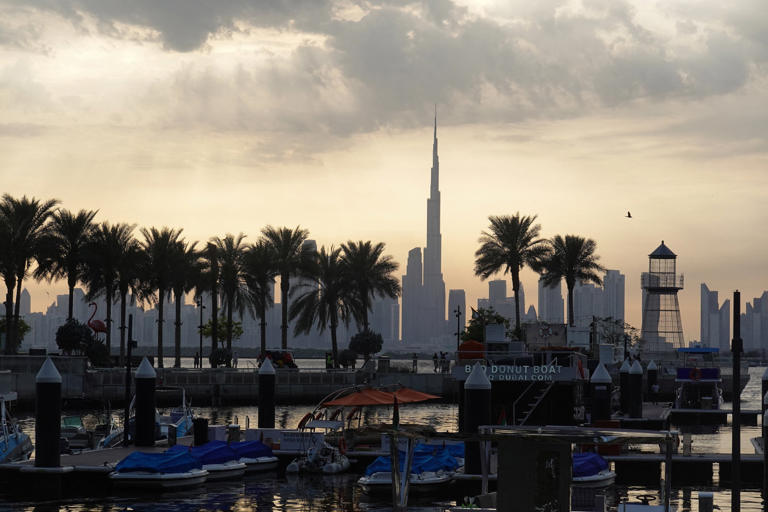
As the war between the U.S., Israel, and Iran shows signs of prolonged conflict, Dubai in the United Arab Emirates (UAE) has seen a steady exodus of foreign residents and tourists. Once dubbed the “golden playground” of billionaires, the city is now being described as a “ghost town” after just two weeks of war-related fallout.
According to a report by The Guardian on the 11th, since Iran began retaliating against U.S. and Israeli airstrikes on the 28th of last month by launching drones and missiles at key airports and infrastructure in neighboring Gulf states, tens of thousands of residents and tourists have fled Dubai. Over two-thirds of Iran’s retaliatory weapons targeted the UAE.
The concentration of Iran’s attacks on the UAE appears linked to the country’s deep military and intelligence cooperation with Western nations. Dubai, a central hub for finance, tourism, and logistics, likely faced additional pressure due to its economic significance. The Guardian noted, “Dubai was partially targeted because of its close military and intelligence ties with Western countries, as well as its status as a preferred global financial and tourist destination.”
Over 90% of Dubai’s residents are foreigners, drawn by the absence of income, capital gains, and inheritance taxes—factors that have attracted a high concentration of billionaires. However, the war-induced panic has led to a mass exodus, leaving beaches, bars, shopping malls, hotels, and other crowded facilities eerily empty. Even luxury villas, hotels, and the Fairmont Hotel on Dubai’s iconic Palm Jumeirah artificial island have suffered significant damage. Unlike other Gulf states, Dubai’s heavy reliance on tourism—due to its lack of vast oil resources—makes it particularly vulnerable to such shocks.
Based on interviews with expatriates, The Guardian stated, “The foundation of the ‘Dubai Dream’ that foreigners once believed in is now shaking, posing an existential threat.” John Trudinger, a British school principal who has resided in Dubai for his 16th year, said, “Most of the over 100 British teachers here have been deeply traumatized by the sudden war and are struggling to cope. Many have already left and won’t return.”
Experts warn that the longer the war persists, the greater the impact on Dubai. Khaled Almezaini, a professor at UAE Zayed University, said, “While the UAE economy can currently withstand the pressure, if this situation continues for another 10 or 20 days, the effects on tourism, aviation, foreign businesses, and oil will become severe.”
Migrant workers stranded in Dubai face dwindling job opportunities and financial hardship. Zain Anwar, a Pakistani taxi driver, remarked, “I’m one of the luckiest to have survived, but business has dried up, and there’s no income. Tourism doesn’t seem to be recovering. Many taxi drivers like me are considering moving to other countries.” He added, “Everyone knows Dubai is finished.”
Dubai International Airport, which recorded the highest number of international passengers last year, suspended flights indefinitely after Iran’s drone attacks but resumed limited operations on the 2nd. However, it was temporarily shut down again on the 7th due to safety concerns. Reduced operations continue, citing airspace closures.
